







- Home
- Sports Physiotherapy
- Ankle Sprain
Ankle Sprain Physiotherapy in Edmonton
Ankle Sprain Physiotherapy Edmonton
Rolled ankles, high ankle sprains and the ones that never quite settled: assessment, treatment and a stable return to sport
Why Ankle Sprain Physiotherapy Matters
Most people who roll an ankle never get it assessed. Many of them may go on to roll it again because the ligament heals, but balance, strength, and reaction time that help protect the joint may not fully return on their own. Ankle Sprain Physiotherapy Edmonton may include exercises that focus on rebuilding strength, balance, and ankle stability as part of the rehabilitation process.

What an ankle sprain is
A stretch or tear of the ligaments that stabilize the ankle. The classic “rolled ankle” injures the ligaments on the outside (lateral sprain). Less common but slower to recover from is the high ankle sprain, which injures the ligaments joining the two shin bones above the joint. Sprains are graded 1 to 3 by the amount of ligament damage.
Common causes
- Landing on another player’s foot in basketball or volleyball
- Stepping in a hole or off a curb, or on an uneven trail
- Cutting and pivoting in soccer, football and racquet sports
- Edge catches in skating and skiing falls
- Previous sprains that left the ankle less stable
Symptoms
- Pain and swelling on the outside (or, for high sprains, front) of the ankle
- Bruising that may appear a day or two later
- Difficulty bearing weight or pushing off
- A feeling of giving way, especially with repeat sprains
When to get assessed
Within the first few days if you can. Early assessment rules out fracture, grades the sprain and starts the right loading. If your ankle still feels unstable or swells with activity weeks later, it is worth assessing even if the original injury was months ago.
Red flags
Inability to take four steps immediately after the injury, bone tenderness at the back edge of either ankle bone or at the base of the fifth metatarsal, or an obvious deformity should be seen by a physician or urgent care for an X-ray first.

How We Treat Ankle Sprains At In Step
We assess the ligaments, check for fracture risk using the Ottawa ankle rules, and identify whether the sprain is lateral, medial or high, because the plan differs. Early on, we control swelling, protect the ligament with taping or bracing where needed, and get you walking normally as soon as it is safe; prolonged immobilization slows recovery.
The core of rehabilitation is restoring range, strength and, above all, balance and proprioception: the ankle’s ability to sense position and react. This is what prevents the next sprain. Manual therapy helps restore joint motion, and we progress to hopping, cutting and sport-specific drills before clearing you for play.
For chronic instability from old sprains, the same principles apply with a longer strengthening phase, and we refer for a surgical opinion when conservative care is not enough.
Sports Where Ankle Sprains Are Most Common
Basketball and volleyball lead, followed by soccer, football, rugby, dance, trail running and hiking.
Court and field
- Basketball and volleyball: landing on other players
- Soccer, football, rugby, lacrosse: cutting and contact
- Racquet sports: lateral movement
Studio, trail and ice
- Dance and gymnastics: landings and pointe work
- Trail running and hiking: uneven ground
- Skating and snowboarding: edge catches and falls
Returning to Sports After an Ankle Sprain
Most sprains recover well with the right program. High ankle sprains take noticeably longer.
Typical timelines
- Grade 1: one to three weeks to return to sport
- Grade 2: three to six weeks
- Grade 3 or high ankle sprain: six to twelve weeks, occasionally longer
Ranges, not guarantees. Your physiotherapist will give you an estimate after assessment.
Return-to-play criteria we use
- Full range of motion and minimal swelling
- Single-leg balance and hop tests within about ten per cent of the other side
- Pain-free cutting, landing and sport-specific drills
- A plan for bracing or taping if returning early
How Long Does an Ankle Sprain Take to Heal?
Understand the athlete, measure what matters, treat with intent and progress against criteria.
Ready to get this sorted? Start with an assessment.
When Should You Seek Physiotherapy for an Ankle Sprain?
Pages you may also find useful.
Foot and ankle pain
Sports physiotherapy hub
Knee pain

Technologies And Services We Use In Sports Rehabilitation
Objective measurements that change decisions: wearable movement sensors, brain-function measurement in concussion management, neuromuscular stimulation and virtual-reality rehabilitation, alongside hands-on care.
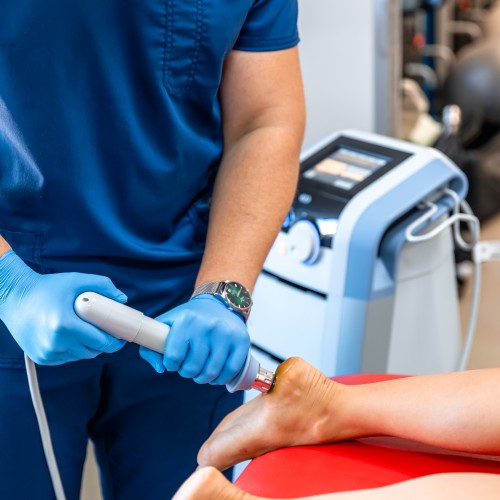
Shockwave Therapy
Breaks down scar tissue, reduces chronic pain, and promotes faster tissue repair.

Footmaxx Orthotics
Custom orthotics to improve walking mechanics and relieve lower limb or back pain.
Insurance Coverage for Ankle Sprain Physiotherapy Edmonton
Most extended health plans in Alberta cover physiotherapy, and we bill most insurers directly. No physician referral is needed to book, though some insurers ask for one to reimburse claims.
Do I need a referral?
No. Physiotherapists in Alberta are primary-contact practitioners. Some insurers ask for a physician referral to reimburse; we can tell you whether yours does.
Which insurers do you bill directly?
Most major extended health providers. Call us before your first visit and we will confirm your coverage.
What if the injury happened at work or in a car accident?
Work injuries are handled through WCB and car-accident injuries through the MVA insurer. We manage the paperwork in both cases.

Why Patients Choose In Step Physical Therapy for Ankle Sprain Physiotherapy Edmonton
At In Step Physiotherapy, we have been serving Downtown Edmonton since 2001, with a team that treats sports and work injuries every day.
Experienced, credentialed team
Our lead physiotherapist has more than 25 years in orthopedic and sports rehabilitation, with FMS, SFMA, Running Performance, TPI golf and IPT concussion certifications.
Treatment and performance under one roof
Injury care and the Return2Play performance program in the same clinic, so recovery flows into prevention.
Objective measurement
Structured strength testing, so return-to-play decisions rest on data as well as judgement.
Direct billing, no referral needed
We bill most extended health insurers directly, and physiotherapists in Alberta are primary-contact practitioners.
Shockwave and dry needling in-clinic
Evidence-supported options for stubborn tendon and muscle problems, used alongside the exercise program that does the real work.
Ready To Get Back To What You Love?
Book a one-on-one assessment with a registered physiotherapist. No referral needed; direct billing to most plans.
What Our Patients Say About Ankle Sprain Physiotherapy Edmonton

FAQs About Ankle Sprain Physiotherapy Edmonton
Understanding the injury
Should I rest a sprained ankle completely?
No. Beyond the first day or two, early protected movement and weight bearing as tolerated lead to faster recovery than prolonged rest.
Do I need an X-ray?
Only if specific signs are present. We apply the Ottawa ankle rules at assessment and refer for imaging when indicated.
Why does my ankle keep giving way?
Repeated sprains usually reflect lost balance, strength and reaction time rather than a loose ligament alone. Targeted rehabilitation addresses this.
Is a brace or tape better?
Both reduce re-sprain risk during return to sport. We recommend based on your sport and how the ankle tests.
How soon can I run again?
Once you can walk normally, hop without pain and balance on the injured leg. For many grade 1 and 2 sprains that is within two to three weeks.
Treatment and recovery
What is a high ankle sprain?
An injury to the ligaments joining the tibia and fibula above the ankle joint. It is less common, more painful with rotation, and slower to heal.
Do I need a referral?
No. Physiotherapists in Alberta are primary-contact practitioners and we bill most insurers directly.
Can an old sprain still be treated?
Yes. Chronic ankle instability responds well to a structured balance and strength program even years later.
How long is the first appointment?
Typically 45 to 60 minutes, including assessment, initial treatment and a home program.
Do you treat children's ankle sprains?
Yes, with attention to growth plates, which can be injured in children where adults would sprain a ligament.
Physiotherapists Who Treat This Every Day





Our team is here to answer your questions and get you moving again
- Address - 10667 113 St NW, Edmonton, AB T5H 3H6
- Phone - (587) 409-1754
- Email - info@instepphysio.ca
- Business Hours - Mon – Fri: 8 am – 8 pm
- Business Hours - Sat: 8 am – 4 pm