






- Home
- Sports Physiotherapy
- Tennis Elbow
Tennis Elbow Physiotherapy in Edmonton
Tennis Elbow Physiotherapy Edmonton
Lateral and medial epicondylalgia from racquet sports, golf, climbing and work: assessment, loading, shockwave and a plan to keep it away
Common Causes of Tennis Elbow Physiotherapy
The outer-elbow pain that makes lifting a kettle or shaking hands unpleasant is often related to tendon overload, and in Edmonton we see it from pickleball, padel, climbing, golf, weight training, and keyboards as often as from tennis. Tennis Elbow Physiotherapy Edmonton may include a progressive loading program to address strength and activity tolerance rather than simply waiting for symptoms to settle.

What tennis elbow and golfer's elbow are
Tennis elbow (lateral epicondylalgia) is an overload of the tendons that extend the wrist, where they attach to the outside of the elbow. Golfer’s elbow (medial epicondylalgia) is the same problem on the inside, involving the tendons that flex the wrist and grip. Despite the old name “epicondylitis”, these are usually degenerative tendon changes rather than inflammation, which is why anti-inflammatories alone rarely fix them.
Common causes
- A sudden increase in racquet sport volume, or a new sport such as pickleball
- Grip-heavy activities: climbing, weight training, tools, gardening
- Golf, especially with changes in swing or club
- Repetitive keyboard and mouse work
- Weak shoulder and forearm muscles leaving the tendon to do the work
Symptoms
- Pain on the outside (tennis) or inside (golfer’s) of the elbow, often spreading down the forearm
- Pain when gripping, lifting with the palm down, shaking hands or turning a door handle
- Morning stiffness and weakness of grip Tenderness directly over the bony point of the elbow
When to get assessed
If elbow pain has lasted more than two weeks, is affecting sleep or grip, or has returned after settling. Early treatment shortens the course significantly; long-standing cases can take months.
Red flags
Elbow pain with numbness or tingling in the hand, swelling or redness over the joint, pain after a fall or a locked elbow should be assessed by a physician to rule out nerve involvement, fracture or joint problems.

How We Treat Tennis Elbow At In Step Physiotherapy
Assessment confirms that the tendon is the source and rules out the neck, the nerve and the joint, which can all refer pain to the elbow. We check grip and wrist strength objectively, and look at shoulder and trunk control, because tendons at the elbow overload when the shoulder is not doing its share.
Treatment is built around progressive tendon loading: isometric holds early for pain relief, then eccentric and heavy slow resistance work that stimulates the tendon to adapt. Manual therapy, dry needling and taping can help with pain and grip in the short term. For stubborn cases that have not responded to loading, shockwave therapy is an evidence-supported option we offer in-clinic.
We also address the cause: racquet grip size and string tension, technique, training volume, or workstation setup, so the problem does not return.
Sports and Activities Where Tennis Elbow Is Common
Racquet sports and golf, then climbing, strength training and manual work.
Racquet and precision sports
- Tennis, pickleball, padel, badminton and squash
- Golf (both sides of the elbow)
- Baseball and softball throwing (medial side)
Grip-heavy activities
- Climbing and bouldering
- CrossFit, weightlifting and rowing
- Trades, gardening and desk work
Tennis Elbow Physiotherapy Treatment Edmonton
Tendons adapt slowly. Improvement is usually steady rather than sudden.
Typical timelines
- Recent cases (under three months): often six to twelve weeks
- Long-standing cases: three to six months, occasionally longer
Consistency with the loading program is the biggest factor. These are ranges, not guarantees.
Return-to-play criteria we use
- Pain-free grip strength within about ten per cent of the other side
- Tolerance of loaded wrist extension or flexion
- Graded return to serving, hitting, climbing or lifting volume
- Equipment and technique changes in place
How Is Tennis Elbow Assessed?
Understand the athlete, measure what matters, treat with intent and progress against criteria.
Ready to get this sorted? Start with an assessment.
How Long Does Tennis Elbow Take to Improve?
Pages you may also find useful.
Elbow, wrist and hand physiotherapy
Shockwave therapy
Sports physiotherapy hub

Technologies And Services We Use In Sports Rehabilitation
Objective measurement that changes decisions: wearable movement sensors, brain-function measurement in concussion management, neuromuscular stimulation and virtual-reality rehabilitation, alongside hands-on care.
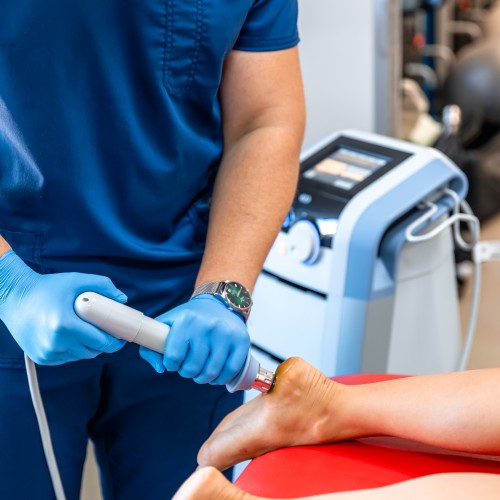
Shockwave Therapy
Breaks down scar tissue, reduces chronic pain, and promotes faster tissue repair.
Is Treatment Covered By Insurance?
Most extended health plans in Alberta cover physiotherapy, and we bill most insurers directly. No physician referral is needed to book, though some insurers ask for one to reimburse claims.
Do I need a referral?
No. Physiotherapists in Alberta are primary-contact practitioners. Some insurers ask for a physician referral to reimburse; we can tell you whether yours does.
Which insurers do you bill directly?
Most major extended health providers. Call us before your first visit and we will confirm your coverage.
What if the injury happened at work or in a car accident?
Work injuries are handled through WCB and car-accident injuries through the MVA insurer. We manage the paperwork in both cases.

Why Patients Choose In Step Physical Therapy for Tennis Elbow. Physiotherapy
At In Step Physiotherapy, we have been serving Downtown Edmonton since 2001, with a team that treats sports and work injuries every day.
Experienced, credentialed team
Our physiotherapist has more than 25 years in orthopedic and sports rehabilitation, with FMS, SFMA, Running Performance, TPI golf and ITPT concussion certifications.
Treatment and performance under one roof
Injury care and the Return2Play performance program in the same clinic, so recovery flows into prevention.
Objective measurement
Structured strength testing, so return-to-play decisions rest on data as well as judgement
Direct billing, no referral needed
We bill most extended health insurers directly, and physiotherapists in Alberta are primary-contact practitioners.
Shockwave and dry needling in-clinic
Evidence-supported options for stubborn tendon and muscle problems, used alongside the exercise program that does the real work.
Ready to get back to what you love?
Book a one-on-one assessment with a registered physiotherapist. No referral needed, direct billing to most plans.
What Our Patients Say About Tennis Elbow Physiotherapy Edmonton

FAQs About Tennis Elbow Physiotherapy Edmonton
Understanding the injury
Should I wear a tennis elbow brace?
A counterforce brace can reduce pain during activity and is reasonable to use while the loading program takes effect. It does not replace treatment.
Does shockwave work for tennis elbow?
Evidence supports it for cases that have not responded to loading. We usually combine it with the exercise program rather than using it alone.
Should I stop playing?
Usually not entirely. We modify volume, grip and technique and keep you playing where possible.
Is it inflammation?
Mostly no. Long-standing tennis elbow is a tendon degeneration problem, which is why loading exercises work better than anti-inflammatories alone.
Can a cortisone injection fix it?
Injections can reduce pain short term but are associated with worse outcomes at one year in several studies. Discuss with your physician; loading remains the foundation.
Treatment and recovery
Why does my elbow hurt after switching to pickleball?
The new sport loads the wrist extensors differently and often in higher volume. Gradual build-up and a short strength program prevent most cases.
Do I need a referral?
No. Physiotherapists in Alberta are primary-contact practitioners and we bill most insurers directly.
Is golfer's elbow treated the same way?
Similar principles, applied to the wrist flexor tendons on the inside of the elbow, with attention to throwing or swing mechanics.
How long is the first appointment?
Typically 45 to 60 minutes, including assessment, initial treatment and a home program.
Can my neck cause elbow pain?
Yes. Neck and nerve problems can mimic tennis elbow, which is why we screen them at assessment.
What Our Patients Say About In Step Physiotherapy



Our team is here to answer your questions and get you moving again
- Address - 10667 113 St NW, Edmonton, AB T5H 3H6
- Phone - (587) 409-1754
- Email - info@instepphysio.ca
- Business Hours - Mon – Fri: 8 am – 8 pm
- Business Hours - Sat: 8 am – 4 pm